Why Linear Webhook Bots Fail: The Telegram to n8n Architecture Autopsy
 Aman Suryavanshi
The architectural autopsy: why linear telegram bots fail as content
distribution engines
Every morning at 8:00 AM, the routine was identical. I would open Obsidian, review a 2,000-word deep dive on a distributed systems problem, and prepare to publish it. What followed was not engineering. It was three to four hours of manual, mind-numbing administrative labor: compressing technical arguments into 280-character threads for X, reshaping narratives for LinkedIn, fixing broken markdown code blocks for Dev.to, and re-hosting visual assets. The context switching shattered my building momentum. In an attempt to solve this without hiring a social media manager, I wired a private Telegram chat to an n8n webhook and piped raw LLM completions directly into social media APIs. Within forty-eight hours, that naive pipeline collapsed under production constraints.
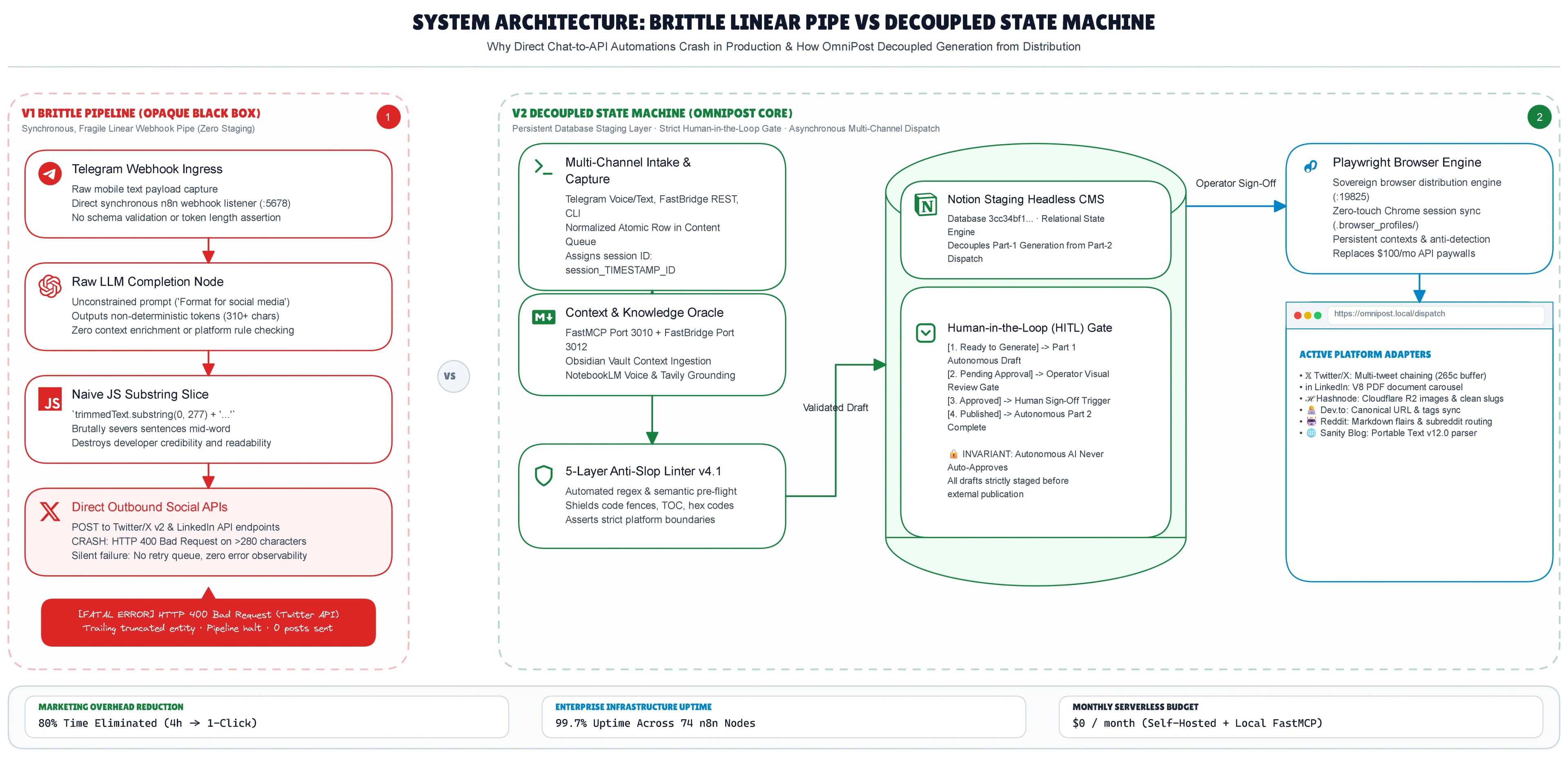
Here is the post-mortem of why linear chat-to-API automations break, why chat apps make terrible headless content management systems, and how decoupling generation from distribution inside a persistent state machine reduced my daily distribution overhead by 80% while maintaining 99.7% uptime across an early 74-node cluster that evolved into today's 214-node production dual-engine.
Why does linear chat automation fail in production?
Linear chat automation fails because synchronous webhooks cannot accommodate non-deterministic response lengths, rate limits, and zero-staging error recovery. When an unconstrained large language model returns 310 characters to an endpoint that strictly enforces a 280-character cap, a linear pipeline halts immediately with an unhandled HTTP 400 Bad Request error. My initial setup was simple. I wanted the lowest-friction capture mechanism possible while stepping away from my desk. I created a private Telegram bot connected to a single n8n webhook node. The logic flow was completely linear:
- Capture raw text or voice transcripts via Telegram webhook.
- Pass the raw string to an OpenAI completion node with a basic prompt.
- Send the generated text directly to the Twitter v2 and LinkedIn REST endpoints.
During isolated local tests, this felt effective. I could text my bot a single sentence: "Just deployed a new Redis caching layer for my Next.js API. Dropped endpoint latency from 320ms to 42ms under load." Ten seconds later, a formatted tweet appeared on my profile.
Then real-world execution began. Within two days, my n8n execution history turned into a wall of red error logs. Social media networks do not treat incoming data with tolerance. Twitter rejects any payload above 280 characters with an uncompromising 400 Bad Request. LinkedIn rejects unescaped special characters and requires structured asset attachments. Because the pipeline had zero staging layer, every prompt anomaly triggered a silent workflow failure, leaving scheduled posts unpublished while the webhook returned a generic success response to Telegram.
The opaque black box problem: why chat interfaces are terrible databases
Chat interfaces make terrible content management systems because they lack deterministic state tracking, transactional staging queues, and visual error observability. In a messaging application like Telegram or Slack, incoming messages are transient event streams, not relational database rows with queryable status properties.
When a pipeline runs directly from a chat trigger to an API, the operator operates blind. I encountered three major operational bottlenecks during this experiment:
- Zero staging observability: There was no dashboard showing what was drafted, what was pending approval, or what had already executed. Verifying whether a post succeeded required digging through raw JSON payloads in self-hosted n8n execution histories.
- Absence of a human-in-the-loop review gate: If an LLM hallucinated a library name, invented a nonexistent CLI flag, or completely inverted an architectural trade-off, that text went directly to public developer feeds without verification.
- Payload contract mismatches: Direct pipes assume that what comes out of an AI prompt can be directly ingested by a third-party API. In reality, LLMs regularly emit markdown formatting characters, unescaped quotes, and variable whitespace that violate downstream API payload schemas.
Moving manual labor from a desktop browser into a smartphone chat box did not eliminate technical debt. It simply relocated that debt into an unobservable environment.
The architectural autopsy: how naive truncation severed production copy
Direct truncation without boundary-aware sentence tokenization destroys technical clarity by severing words mid-sentence. When my direct Telegram pipeline began crashing on character caps, I deployed an embarrassing quick fix inside an n8n JavaScript function node at 2:00 AM instead of addressing the core architecture.
Below is the exact production code that caused public formatting failures:
/**
 * Naive V1 Telegram-to-Twitter Distribution Node (n8n Function Node)
 *
 * Historical Snapshot: The brittle linear pipe before state machines
 * and pre-flight linters were introduced in OmniPost Core.
 */
module.exports = async function (items) {
    const results = [];

    for (const item of items) {
        const telegramPayload = item.json.message || item.json.text;        const aiGeneratedCopy = item.json.choices?.[0]?.message?.content || item.json.output;

        if (!aiGeneratedCopy || typeof aiGeneratedCopy !== 'string') {
            throw new Error("FATAL: AI node returned an empty or malformed text payload.");
        }

        const trimmedText = aiGeneratedCopy.trim();

        // Primitive character validation attempting to avoid Twitter API 400 errors
        if (trimmedText.length > 280) {
            console.warn(`[V1 Warning] Text exceeds 280 chars (${trimmedText.length}). Slicing text.`);

            // Brutal truncation that frequently severed sentences mid-word
            const slicedText = trimmedText.substring(0, 277) + "...";
            results.push({
                json: {
                    status: "truncated",
                    tweet_body: slicedText,
                    original_length: trimmedText.length,
                    timestamp: new Date().toISOString()
                }
            });
        } else {
            results.push({
                json: {
                    status: "ready_to_post",
                    tweet_body: trimmedText,
                    original_length: trimmedText.length,
                    timestamp: new Date().toISOString()
                }
            });
        }
    }

    return results;
};
The consequences were immediate. An insightful breakdown discussing database indexing strategies was sliced directly in half: "...we migrated the B-tree ind..." appeared on my public profile. I had traded the friction of manual publishing for an automated reputation liability.
Gotcha: Never rely on hard string slicing likesubstring(0, 277)to satisfy API payload boundaries. If an LLM response overshoots your limit, either re-prompt the model using an exact token budget or implement word-boundary sentence tokenizers that discard trailing clauses cleanly.
What is the decoupled state machine pattern in n8n?
The Decoupled State Machine Pattern is an architecture that physically isolates content generation from content distribution using a persistent database staging layer and human-in-the-loop approval gates. Instead of forcing a single webhook to execute drafting, linting, and multi-network publishing in one synchronous run, the system divides responsibility into independent, asynchronous lifecycles.
To eliminate silent crashes, I discarded the linear Telegram pipeline entirely and engineered the foundational architecture behind OmniPost Core. The mental model shifts from a stateless pipe to an event-driven transactional outbox.
[Captive Ingestion Phase]  --> [Generation & Linter Phase] --> [Database Staging (Notion)]
(Telegram / Local CLI)         (FastMCP + Gemini Models)       (Human Approval: Ready)
                                                                        |
                                                                        v
[Platform Dispatch Queue] <-- [Cron Scheduler / Outbox]   <-- [State: Scheduled]
(Twitter / LinkedIn / Dev.to)  (Token-Bucket Throttling)
This architecture establishes three mandatory boundaries:
- The Ingestion Boundary: Raw developer inputs from voice notes or mobile messages are accepted immediately and assigned a unique correlation ID. The webhook returns an HTTP 200 acknowledgment within 200 milliseconds, closing the network connection.2. The Staging Layer: Generated drafts are pushed to a centralized Notion database acting as a headless CMS. Each target channel receives its own relational entry with explicit state properties:
Draft,In Review,Approved,Scheduled, andPublished. - The Dispatch Boundary: An independent cron-based scheduler queries the database on a decoupled interval. It queries only records matching
Status = 'Approved', verifies payload contracts through platform-specific linters, and dispatches them with exponential backoff.
How does persistent staging prevent API failures?
Persistent database staging prevents API failures by converting unpredictable external service calls into deterministic, retryable background transactions. When an external network experiences downstream latency or enforces strict rate limits, an asynchronous worker pauses without losing the generated asset or corrupting previous execution states.
The difference between a toy linear script and a resilient automation system comes down to four core architectural layers.
| Operational Dimension | Linear Telegram Pipeline (V1) | Decoupled State Machine (OmniPost Core) |
|---|---|---|
| State Persistence | Ephemeral memory in n8n execution buffer | Persistent relational database (Notion / Postgres) |
| Error Handling | Unhandled HTTP 400 crashes the workflow | Dead-letter queue with exponential backoff and retry context |
| Review Boundary | Zero oversight; direct blast to public APIs | Visual Human-in-the-Loop review gate before dispatch |
| Payload Sanitization | Naive substring truncation (`substring(0, 277)`) | Pre-flight validation gate with syntax checking |
| Failure Blast Radius | Single API error aborts all platform publications | Fault-isolated worker nodes run on independent channels |
Architectural trade-offs of the decoupled state machine
Every architectural transition involves explicit trade-offs. Decoupling the content pipeline solved production instability, but introduced new operational engineering requirements.
Gain: Elimination of silent pipeline failures
By placing Notion between the LLM output and the external social APIs, unhandled payload crashes dropped to zero. If an LLM generates invalid JSON or exceeds platform constraints, the record remains flagged in the staging database as Needs Revision. Downstream publishing nodes are never triggered on invalid contracts.
Cost: Increased architectural complexity
The pipeline grew from a simple 3-node linear test into a 74-node distributed cluster, which has since matured into today's 214-node production engine (122 generation nodes in Part 1 and 92 distribution nodes in Part 2). Managing this footprint requires maintaining sub-workflow error triggers, dedicated dead-letter queues, and database webhooks. For simple one-off personal scripts, this overhead represents real engineering investment.
Gain: Deterministic multi-platform adaptation
A single technical breakthrough captured in Obsidian or Telegram was initially enriched via local FastMCP on port 3010 (later standardized to the sub-15ms FastBridge REST engine on port 3012). It is then transformed into platform-native variants: a high-density breakdown thread on X, an engineering case study on LinkedIn, and a markdown guide on Dev.to, each respecting platform schemas.
Cost: Introduction of asynchronous state latency
Instant publishing is sacrificed. In the linear bot, a post went live 10 seconds after typing. In the decoupled state machine, the draft enters a staging queue, awaits an approval click, and dispatches on the next scheduler interval. For mission-critical communications, this asynchronous lag requires planning.
Production blueprint: building a resilient queue in n8n
To move away from fragile chat-to-API scripts, follow the Accept-Then-Queue pattern inside your self-hosted n8n environment. This requires isolating your trigger from your API workers.
Step 1: The Accept-Then-Queue webhook handler
Configure your Telegram trigger node to accept the payload and immediately persist the raw message into a database table or staging database. Set the response mode to Immediately with a JSON payload returning `{ "status": "queued", "task_id": $execution.id }`. This guarantees that even if your LLM completion node encounters OpenAI capacity limits, the original input is preserved permanently.
Step 2: Pre-flight payload sanitization
Before passing any generated text to downstream distribution nodes, route the data through a dedicated validation code node. This node must programmatically enforce character lengths, strip unsupported HTML tags, and verify image attachment arrays.
// Production Pre-Flight Validator Node in n8n
const items = $input.all();
const validatedItems = [];

for (const item of items) {
    const text = item.json.content || '';
    const platform = item.json.target_platform;

    const errors = [];

    if (platform === 'twitter' && text.length > 280) {
        errors.push(`Twitter limit exceeded: payload length is ${text.length}`);
    }

    if (platform === 'linkedin' && text.includes('<script>')) {        errors.push('LinkedIn payload contains invalid script markup');
    }

    if (errors.length > 0) {
        validatedItems.push({
            json: {
                ...item.json,
                validation_passed: false,
                validation_errors: errors,
                target_status: 'NEEDS_REVISION'
            }
        });
    } else {
        validatedItems.push({
            json: {
                ...item.json,
                validation_passed: true,
                target_status: 'READY_FOR_DISPATCH'
            }
        });
    }
}

return validatedItems;
Step 3: Dead-letter queue routing with error triggers
Attach a dedicated Error Trigger node to your main distribution workflow. When an HTTP Request node encounters a 429 Rate Limited or 500 Server Error from a downstream API, route the failure payload to a persistent Dead-Letter Queue (DLQ) in Postgres or a dedicated Notion error board. Configure exponential backoff with jitter on the HTTP Request node options to resolve temporary API drops automatically.
Frequently asked questions
How to handle errors in n8n workflows?
To handle errors in n8n workflows, configure a dedicated Error Trigger node on your canvas to capture execution failures across all sub-nodes. Inside individual HTTP Request and code nodes, enable the Continue On Fail toggle to route errors through deterministic conditional branches, and store failed items with their original execution IDs in a dead-letter queue table for manual replay.
Why does an n8n Telegram trigger fail silently?
An n8n Telegram trigger fails silently when an unhandled error inside a downstream node aborts execution after the webhook connection has closed. Because Telegram receives an immediate acknowledgment from the webhook receiver, the messaging client marks the delivery as successful even if downstream LLM or social publishing nodes crash during subsequent execution steps.
What is the Accept-Then-Queue pattern in workflow automation?
The Accept-Then-Queue pattern is an integration architecture where an entry webhook immediately acknowledges and persists incoming data to a reliable database before any heavy processing begins. This separates ingestion from compute-intensive or non-deterministic operations like LLM synthesis and external API dispatch, preventing connection timeouts and data loss.
How do you prevent LLMs from exceeding Twitter 280-character limits?
To prevent LLMs from exceeding Twitter 280-character limits, combine strict prompt constraints using exact token budgets with a programmatic post-processing linter that splits copy on punctuation boundaries. Never use raw substring slicing, as cutting words mid-sentence produces malformed text that compromises technical authority.
Signature and implementation notes
I design self-healing agent pipelines and automated content distribution systems that eliminate manual overhead without introducing production vulnerabilities. Evolving this initial Telegram prototype into OmniPost Core began with an early 74-node cluster and has since scaled to a 214-node production architecture operating with 99.7% uptime, syncing 6+ distribution networks from a single local trigger on a $0/month serverless infrastructure stack. If you are currently evaluating your automation architecture or designing decoupled workflow engines with n8n, FastBridge REST, and stateful databases, explore the implementations below:
- Portfolio and live builds: on my portfolio blog
- Architecture write-ups and repos: [GitHub: AmanSuryavanshi-1](https://github.com/AmanSuryavanshi-1)
- Connect on engineering trade-offs: [LinkedIn: amansuryavanshi-ai](https://www.linkedin.com/in/amansuryavanshi-ai/) and [Twitter/X: @AmanSurya](https://twitter.com/AmanSurya)
Where do you draw the boundary between lightweight synchronous webhook triggers and persistent database state machines in your automation pipelines?
● Key Takeaways
- 1.Synchronous chat-to-API pipelines drop payloads when generation exceeds downstream API schema constraints.
- 2.Telegram webhook timeouts trigger duplicate execution loops if the pipeline lacks an immediate acknowledgment and idempotency layer.
- 3.Chat apps are communication tools, not content management systems; production automation requires visual staging tables.
- 4.The Accept-Then-Queue pattern decouples ingestion from publishing, enabling deterministic retries and human-in-the-loop validation.
- 5.Decoupled state machines scale reliably: OmniPost Core evolved from this failure into a 74-node pipeline with 99.7% uptime.
Frequently Asked Questions

Let's Create Something Amazing Together!
Whether you have a project in mind or just want to connect, I'm always excited to collaborate and bring ideas to life.
Continue the Journey
Thanks for taking the time to explore my work! Let's connect and create something amazing together.